Code Mode
Code Mode lets you write full Python trading strategies using the Freqtrade strategy API. This gives you complete control over every aspect of your strategy — custom indicators, advanced callbacks, hyperopt parameters, and any logic that fits inside the Freqtrade contract.
Code Mode is available on Pro and Enterprise plans.
Getting Started
- Navigate to Strategies → New Strategy
- Select Code Mode
- Write your strategy in the Monaco code editor
- Click Save Strategy
Strategy Structure
A VolatiCloud strategy is a standard Freqtrade strategy class.
from freqtrade.strategy import IStrategy, IntParameter, DecimalParameter
from pandas import DataFrame
import talib.abstract as ta

class MyStrategy(IStrategy):
    # Required: candle timeframe
    timeframe = '1h'

    # Required: stop-loss (-10%)
    stoploss = -0.10

    # Optional: ROI table
    minimal_roi = {
        "60": 0.01,    # 1% profit after 60 minutes
        "30": 0.02,    # 2% profit after 30 minutes
        "0": 0.04      # 4% profit immediately
    }

    def populate_indicators(self, dataframe: DataFrame, metadata: dict) -> DataFrame:
        # Add indicators to dataframe
        dataframe['rsi'] = ta.RSI(dataframe, timeperiod=14)
        dataframe['ema_200'] = ta.EMA(dataframe, timeperiod=200)

        macd = ta.MACD(dataframe)
        dataframe['macd'] = macd['macd']
        dataframe['macdsignal'] = macd['macdsignal']

        bollinger = ta.BBANDS(dataframe, timeperiod=20, nbdevup=2, nbdevdn=2)
        dataframe['bb_upper'] = bollinger['upperband']
        dataframe['bb_lower'] = bollinger['lowerband']
        dataframe['bb_mid'] = bollinger['middleband']

        return dataframe

    def populate_entry_trend(self, dataframe: DataFrame, metadata: dict) -> DataFrame:
        # Define entry conditions
        dataframe.loc[
            (dataframe['rsi'] < 30) &
            (dataframe['close'] > dataframe['ema_200']),
            'enter_long'
        ] = 1
        return dataframe

    def populate_exit_trend(self, dataframe: DataFrame, metadata: dict) -> DataFrame:
        # Define exit conditions
        dataframe.loc[
            dataframe['rsi'] > 70,
            'exit_long'
        ] = 1
        return dataframe
Key Methods
populate_indicators
Calculate technical indicators and add them to the dataframe. This runs once per new candle.
def populate_indicators(self, dataframe: DataFrame, metadata: dict) -> DataFrame:
    # metadata['pair'] contains the current pair, e.g., 'BTC/USDT'
    dataframe['rsi'] = ta.RSI(dataframe, timeperiod=14)
    return dataframe
populate_entry_trend
Set enter_long = 1 rows where you want to open long positions. Set enter_short = 1 for shorts.
def populate_entry_trend(self, dataframe: DataFrame, metadata: dict) -> DataFrame:
    dataframe.loc[
        (dataframe['rsi'] < 30) &
        (dataframe['volume'] > 0),
        'enter_long'
    ] = 1
    return dataframe
populate_exit_trend
Set exit_long = 1 where you want to close long positions. Use exit_short = 1 for shorts.
custom_stoploss (optional)
Define dynamic stop-loss based on current trade data:
def custom_stoploss(self, pair: str, trade, current_time, current_rate,
                    current_profit: float, **kwargs) -> float:
    # Trail stop-loss at 1% below the 20-candle high
    if current_profit > 0.02:
        return -0.01  # Tight stop after 2% profit
    return self.stoploss  # Use default otherwise
Hyperparameters
Use IntParameter and DecimalParameter to define tunable parameters for hyperopt.
class MyStrategy(IStrategy):
    # Define tunable parameters
    buy_rsi = IntParameter(20, 40, default=30, space='buy')
    sell_rsi = IntParameter(60, 80, default=70, space='sell')
    ema_period = IntParameter(50, 300, default=200, space='buy')

    def populate_entry_trend(self, dataframe: DataFrame, metadata: dict) -> DataFrame:
        dataframe.loc[
            dataframe['rsi'] < self.buy_rsi.value,
            'enter_long'
        ] = 1
        return dataframe
VolatiCloud's strategy analyzer automatically discovers these declarations and pre-populates them in the hyperopt UI — no manual entry required.
Long/Short Strategies
For futures trading with both long and short positions:
class LongShortStrategy(IStrategy):
    can_short = True

    def populate_entry_trend(self, dataframe: DataFrame, metadata: dict) -> DataFrame:
        # Long entry
        dataframe.loc[dataframe['rsi'] < 30, 'enter_long'] = 1
        # Short entry
        dataframe.loc[dataframe['rsi'] > 70, 'enter_short'] = 1
        return dataframe

    def populate_exit_trend(self, dataframe: DataFrame, metadata: dict) -> DataFrame:
        # Close longs
        dataframe.loc[dataframe['rsi'] > 70, 'exit_long'] = 1
        # Close shorts
        dataframe.loc[dataframe['rsi'] < 30, 'exit_short'] = 1
        return dataframe
Available Libraries
The following Python libraries are available in Code Mode.
| Library | Purpose |
|---|---|
ta-lib | Technical analysis (via talib) |
pandas | Data manipulation |
numpy | Numerical computing |
pandas_ta | Additional technical indicators |
freqtrade.strategy | Strategy base classes and utilities |
Code Editor Features
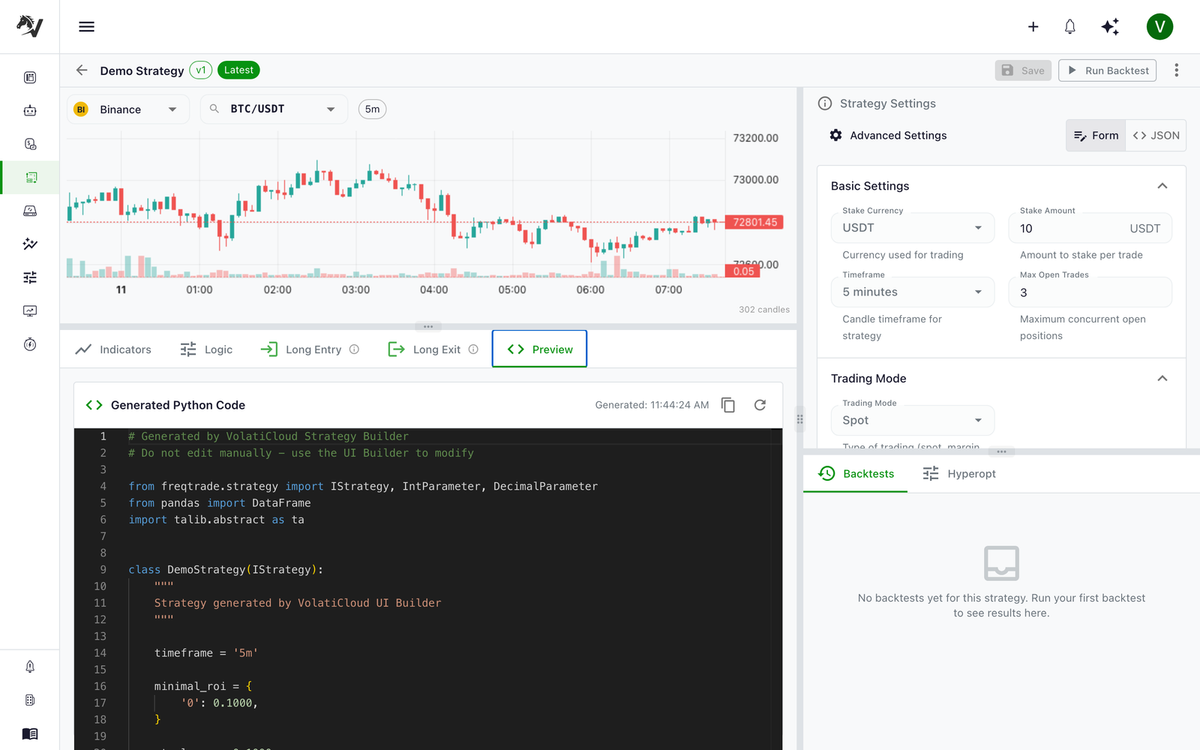
The integrated Monaco editor provides:
- Syntax highlighting for Python
- Auto-completion for common patterns
- Inline lint markers from the strategy analyzer (errors, warnings, info — see Insights tab)
- Line numbers and code folding
Saving and Versioning
Every time you click Save Strategy:
- A new immutable version is created
- The previous version is preserved
- Backtests linked to old versions remain valid
- Bots continue running the version they were configured with
See the versioning guide for the full lifecycle.
Testing Your Strategy
Before deploying live:
- Save your strategy and review the Insights tab for lint errors
- Run a Backtest to validate historical performance
- Deploy as Dry Run bot to test real-time behavior
- Only then switch to Live mode
Common Patterns
Moving Average Crossover
def populate_indicators(self, dataframe: DataFrame, metadata: dict) -> DataFrame:
    dataframe['ema_fast'] = ta.EMA(dataframe, timeperiod=9)
    dataframe['ema_slow'] = ta.EMA(dataframe, timeperiod=21)
    return dataframe

def populate_entry_trend(self, dataframe: DataFrame, metadata: dict) -> DataFrame:
    dataframe.loc[
        (dataframe['ema_fast'] > dataframe['ema_slow']) &
        (dataframe['ema_fast'].shift(1) <= dataframe['ema_slow'].shift(1)),
        'enter_long'
    ] = 1
    return dataframe
Bollinger Band Bounce
def populate_entry_trend(self, dataframe: DataFrame, metadata: dict) -> DataFrame:
    dataframe.loc[
        dataframe['close'] < dataframe['bb_lower'],
        'enter_long'
    ] = 1
    return dataframe

def populate_exit_trend(self, dataframe: DataFrame, metadata: dict) -> DataFrame:
    dataframe.loc[
        dataframe['close'] > dataframe['bb_mid'],
        'exit_long'
    ] = 1
    return dataframe
Related guides
- Strategies Overview — Trading modes, position direction, and strategy concepts.
- UI Builder walkthrough — Assemble the same logic from conditions instead of Python.
- Strategy Versioning — How immutable versions protect your live bots.
- Backtesting Overview — Validate your code-mode strategy against historical data.
- Blog: Strategy Analysis & Insights — Live lint, risk profile, and hyperopt parameter discovery for code-mode strategies.
- Blog: Multi-Timeframe Strategies —
informative_pairsand@informativedecorator patterns.