How Exchange Fees Silently Kill Your Crypto Bot's P&L

A 0.1% taker fee sounds trivial. On a $1,000 position, that's $1 out the door. Easy to dismiss. But a bot cycling in and out of positions 500 times a year pays $500 in fees on that same $1,000 — a full 50% drag before the market has moved a single tick in your favor. Fee optimization is one of the fastest ways to improve a live strategy's returns without touching the signal logic.
Maker vs Taker Fees: The Rate Your Bot Actually Pays
Every centralized exchange charges two fee rates:
- Maker fees apply when your order adds liquidity — you submit a limit order that sits in the order book and waits for a counterparty.
- Taker fees apply when your order removes liquidity — you submit a market order or a limit order that fills immediately against existing book orders.
Taker fees are higher. On most major venues the gap is 30–50%: an exchange charging 0.04% maker / 0.06% taker costs 50% more when you're a taker. The rates are public; the problem is that most bots pay taker fees on every trade without their operators realizing it.
The order type your strategy uses decides which rate you pay. A bot configured for market entries and exits is a taker on every fill:
"order_types": {
    "entry": "market",
    "exit": "market",
    "emergency_exit": "market",
    "stoploss": "market"
}
Market orders are always takers. Unless you explicitly configure limit-order entries with a price offset that lets them rest in the book, your bot pays the higher rate on every round-trip. Moving entries and exits to limit orders is the most direct way to shift from the taker rate to the maker rate.
The Math Behind Fee Drag
The table below shows how taker fees compound over a year of active trading. This uses a standard 0.10% taker fee (0.20% round-trip) as the baseline:
| Trades/year | Fee per round-trip | Annual fee drag |
|---|---|---|
| 100 | 0.20% | 20% of notional |
| 250 | 0.20% | 50% of notional |
| 500 | 0.20% | 100% of notional |
| 1,000 | 0.20% | 200% of notional |
A scalping bot executing 1,000 round-trips per year needs to generate 200% in gross return just to break even on fees — before slippage, spread cost, or any adverse market move. Even a moderate 250-trade/year swing strategy bleeds 50% of its notional to fees annually.
This is not hypothetical: strategies that appear profitable in zero-fee backtests routinely flip to net losers once realistic fees are applied. The performance delta between accurate fee modeling and optimistic fee modeling is often the difference between a deployable strategy and an expensive learning exercise.
Backtesting Accurately: Match the Fee to Your Exchange Account
Freqtrade uses a fee configuration parameter that applies to every simulated entry and exit in a backtest or hyperopt run. When you launch a backtest through VolatiCloud, this is the field that controls how fees are deducted from each trade.
The default Freqtrade fee is 0.0025 (0.25%). That is intentionally conservative — it stress-tests strategies against higher-than-typical fees. But it's not accurate for live P&L projection on a specific exchange at a specific fee tier.
Set your fee to match reality. A strategy backtested at 0.25% that shows +32% annual return might show +55% at accurate Binance futures taker fees (0.05%). Both numbers are correct — they just apply to different configurations. Running at an over-stated fee doesn't just understate performance; it can cause Hyperopt to select parameter sets optimized for a fee regime that doesn't exist in production.
Practical fee values by exchange and market:
// Binance spot, standard tier
{ "fee": 0.001 }

// Binance spot with BNB discount (~25% off)
{ "fee": 0.00075 }

// Binance/Bybit futures, standard tier
{ "fee": 0.0005 }

// Hyperliquid perpetuals, taker
{ "fee": 0.00035 }

// Kraken spot, standard tier
{ "fee": 0.0026 }
Set the fee value in your strategy's bot configuration before running a backtest. The backtest configuration guide explains where this field lives in the config drawer.
Run the same strategy at three fee levels: 0%, your actual fee, and 2× your actual fee. If the strategy only works at 0% or breaks completely at 2×, it's too fee-sensitive for live deployment. A robust strategy degrades gracefully as fees increase.
Exchange Fee Structures: Where Your Bot Fits
Fee schedules differ significantly across the 14 exchanges VolatiCloud supports. The table below shows approximate standard (non-VIP, non-discount-token) rates — your actual rates will vary based on 30-day volume tier:
| Exchange | Spot Maker | Spot Taker | Futures Maker | Futures Taker |
|---|---|---|---|---|
| Binance | 0.10% | 0.10% | 0.02% | 0.05% |
| Bybit | 0.10% | 0.10% | 0.02% | 0.055% |
| OKX | 0.08% | 0.10% | 0.02% | 0.05% |
| KuCoin | 0.10% | 0.10% | 0.02% | 0.06% |
| Gate.io | 0.20% | 0.20% | 0.015% | 0.05% |
| Kraken | 0.16% | 0.26% | 0.02% | 0.05% |
| Hyperliquid | −0.01% | 0.035% | −0.01% | 0.035% |
Several patterns worth noting:
Futures fees are 2–5× lower than spot. Binance's standard spot taker is 0.10%; its futures taker is 0.05%. For a strategy that runs equally well on either market type, switching to futures halves the fee drag. For a 500-trade/year bot, that's a 50% improvement in fee efficiency before changing a single signal.
Hyperliquid charges negative maker fees. Strategies that consistently place limit orders and let them rest in the book receive a rebate on every filled entry or exit. That structural edge is real and persistent — it's essentially being paid to provide liquidity. Maker-biased strategies that can tolerate occasional non-fills should model Hyperliquid seriously — it is a backtesting and dry-run venue on VolatiCloud, since its agent-wallet auth offers no way to prove a credential cannot move funds out (supported exchanges).
Kraken's spot fees are expensive. The 0.26% standard taker rate is over 5× higher than Binance futures. A strategy that targets Kraken's superior regulatory posture (or its US-compliance guarantees) needs to clear a substantially higher gross return hurdle than the same strategy on a lower-fee venue.
Strategies to Reduce Fee Drag
Trade Fewer Times Per Signal
The most direct lever is trade frequency. All else equal, a 4-hour timeframe strategy trades roughly 6× less than a 30-minute timeframe strategy running the same signal type. That 6× difference in trade count translates directly to 6× lower fee drag. Many strategies that underperform on short timeframes due to fees work well on 1h or 4h where the fee-to-expected-move ratio is more favorable.
Before tuning indicators or entry logic, ask: can this strategy run on a longer timeframe without degrading signal quality? If yes, the fee savings are immediate.
Configure Limit-Order Entries
Freqtrade supports limit entries via:
"order_types": {
    "entry": "limit"
},
"entry_pricing": {
    "price_side": "ask",
    "use_order_book": false,
    "order_book_top": 1
}
Paired with an custom_entry_price implementation that bids slightly below market, this causes entries to rest in the order book as maker orders. Fills are not guaranteed — the price may move away before your order is hit — but when they do fill, you pay the maker rate instead of the taker rate. For a venue with a 0.04% maker / 0.10% taker split, limit entries reduce per-entry fee cost by 60%.
The trade-off: not every signal that meets your criteria will fill. Entry non-fills change the strategy's effective trade count and require careful measurement during backtesting. Use VolatiCloud's backtest result analyzer to monitor fill rates and compare limit vs market entry performance side-by-side.
Stick to Liquid Pairs
Low-liquidity pairs carry wide bid-ask spreads. The spread is an implicit fee on every round-trip — one that doesn't appear in the fee field but does appear in fill prices. A 0.3% spread on a thinly-traded altcoin adds the equivalent of 0.15% to each side, doubling the effective round-trip cost on top of exchange fees. Filtering your pair list to the top-30 by 24-hour volume on your chosen exchange keeps this implicit cost contained.
The historical data availability pre-flight walks through the pair selection process in detail — including how to check whether a pair has enough history for statistically meaningful backtests.
Evaluate Volume-Based Fee Tiers
Most exchanges reduce fees as 30-day trading volume increases. Binance's VIP tiers drop the standard 0.10% taker to 0.04% at higher volume thresholds. If you're running a multi-bot portfolio, concentrating bots on one or two exchanges rather than spreading them across every venue you can trade on may push you into a lower-cost tier across the whole portfolio. VolatiCloud makes this easy — each bot specifies its exchange, so you can reorganize deployments to consolidate volume without changing strategy logic.
For an overview of how to structure a multi-bot setup optimized for overall portfolio risk and fee cost, see multi-bot portfolio orchestration.
Use Native Discount Tokens
Binance (BNB), OKX (OKB), and KuCoin (KCS) each offer 20–25% fee discounts when you pay in their native token with the discount option enabled. This is free money for any bot running on those exchanges — the token balance replenishes automatically from trading proceeds if configured correctly, and the discount applies to every trade.
How VolatiCloud Handles Exchange Fee Configuration
When you connect an exchange to VolatiCloud, the connection manages authentication — your API key, secret, and any required passphrase. The fee your bot pays is determined by your actual account tier on that exchange at trade time; VolatiCloud does not override or approximate it.
For backtesting and hyperopt, you control the simulated fee explicitly through the bot configuration. VolatiCloud applies that fee to every entry and exit in the simulation, producing P&L figures that match what you'd see live if your account is on the modeled tier.
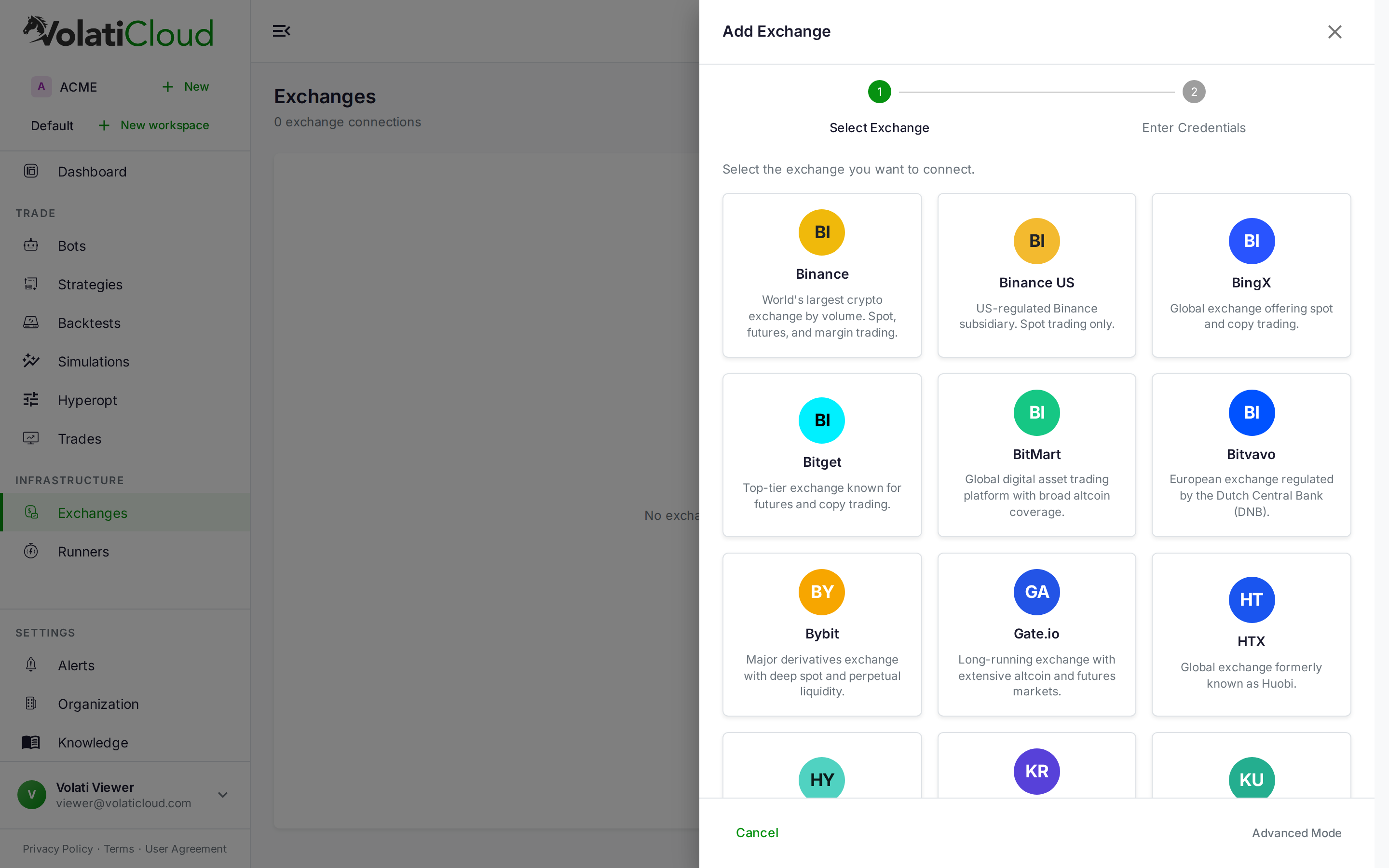
The Exchanges overview documents how to connect each venue through the guided wizard — two steps, under five minutes. The Supported Exchanges page lists per-exchange API setup requirements, including which exchanges need a passphrase and which trading modes (spot, futures, margin) each venue supports.
Never enable withdrawal permissions on an API key you provide to VolatiCloud. VolatiCloud rejects keys with withdrawal access at add time — it's a deliberate safety check. Trade-only keys are all the bot needs, and they limit blast radius if a key is ever compromised. See the Exchange API key security guide for the full breakdown.
A Fee Optimization Checklist Before Going Live
Run through this before deploying any bot:
- Set the backtest fee accurately. Use your exchange account's actual tier rate, not the Freqtrade default.
- Count the trades. A strategy generating 500+ round-trips per year is highly fee-sensitive. Slow it down or switch to futures.
- Compare at least two exchanges. If the strategy works on both Binance and Bybit, model both fee structures. The difference may be small — or it may swing annual P&L by 10–20%.
- Evaluate futures. If your strategy is market-agnostic, futures fees run 2–5× lower than spot.
- Test limit-order entries. If your entry logic allows price flexibility, maker fees reduce per-entry cost by 30–60%.
- Filter illiquid pairs. Wide spreads add implicit cost beyond the stated fee.
- Check fee tiers. If your portfolio volume is near a tier threshold, consolidating may unlock a meaningful discount.
- Enable native token discounts. Free 20–25% savings on supported exchanges.
Connect your exchanges and run fee-accurate backtests at console.volaticloud.com. The Exchanges overview covers the guided wizard, and the backtesting deep-dive explains how to interpret the results once your simulations are running with accurate parameters.