Crypto Scalping Bots: Build and Backtest Short-Timeframe Strategies

Scalping is the fastest game in crypto trading — dozens of trades per day, each capturing a few basis points of price movement. Manually, it's exhausting and error-prone. With a bot, it becomes a repeatable, systematic process — provided you build it right from the start.
The challenge with automated scalping isn't finding a signal; it's surviving the economics. Trading fees, slippage, and API rate limits eat into gains that look compelling on paper but vanish in live execution. This guide covers how to design a scalping strategy that accounts for those realities, how to backtest it properly, and how to configure it in VolatiCloud's Strategy Builder.
Scalping vs Swing Trading: What Changes for Bots
Swing traders hold positions for hours to days, chasing larger price moves. Scalpers hold for minutes, aiming to accumulate small gains that compound. Both approaches work, but they create fundamentally different bot design constraints:
| Dimension | Scalping | Swing Trading |
|---|---|---|
| Timeframe | 1m – 15m | 1h – 1d |
| Trades per day | 10–100+ | 1–5 |
| Fee sensitivity | Very high | Low–medium |
| Indicator lag | Critical | Less critical |
| Slippage impact | Significant | Minor |
| Stop-loss range | 0.3% – 1.0% | 1.5% – 5.0% |
The biggest practical difference is fees. A strategy earning 0.15% per trade on a 4-hour chart is solidly profitable. The same raw performance on a 1-minute chart evaporates when each leg costs 0.05–0.10% in maker/taker fees. Before building any scalping strategy, calculate your net edge after fees. If it's under 0.05% per trade at your target frequency, the strategy probably doesn't work.
Choosing Your Timeframe
Most exchange APIs provide candle data down to 1-minute granularity. Choosing the right timeframe for a scalping bot involves three trade-offs:
Signal quality vs noise. At 1m, price action is dominated by bid-ask spread noise and brief liquidity imbalances. Moving to 3m or 5m smooths this considerably while still generating enough trades to compound gains meaningfully.
Exchange rate limits. Most exchanges cap API calls at 20–60 requests per minute. A 1m strategy making rapid data requests can hit these limits during volatile sessions, causing missed entries or stale data. A 5m strategy requests data five times less frequently.
Fee structure. Exchanges typically offer lower fees for limit orders (maker orders) versus market orders (taker). A scalping bot placing limit orders on a 5m chart with a well-calibrated entry can consistently qualify for maker rates — a difference of 0.05–0.08% per trade that compounds dramatically over hundreds of trades per week.
For most automated scalping strategies, 3m to 5m is the practical sweet spot. The 1m timeframe works on high-volume pairs (BTC/USDT, ETH/USDT on Binance or Bybit) where spreads are tight and fills are reliable, but requires careful fee modeling.
Indicators That Work at Short Timeframes
Indicators designed for daily charts — like a 200-period EMA or standard RSI(14) — are too slow for 1m–5m scalping. The lag compounds at shorter timeframes. Short-period alternatives work better:
Fast EMAs for Micro-Trend Bias
Use two EMAs with a tight ratio — such as EMA(8) and EMA(21) — to identify the immediate micro-trend. An entry signal fires when price is above both EMAs and EMA(8) is above EMA(21) (long bias), or the reverse for short bias with mirror mode.
This differs meaningfully from the EMA crossover strategy suited for 1h+ charts. At 5m, the crossover itself happens too frequently to trade directly; use it as a directional filter, not the trigger.
RSI on Short Periods
A standard RSI(14) at 5m covers roughly 70 minutes of price history. That's useful as a mean-reversion filter. Some scalpers prefer RSI(5) or RSI(7) for faster response, accepting more noise in exchange for quicker signals.
RSI(14) at 5m covers 70 minutes of history. RSI(14) at 1h covers 14 hours. Always sanity-check indicator period against the actual time window it represents — the right period depends on the timeframe, not just the strategy type.
VWAP as an Intraday Bias Filter
Volume Weighted Average Price resets each session and provides a clean intraday benchmark. Price above VWAP suggests buyers are in control; below VWAP suggests sellers. Many scalping strategies restrict entries to one direction based on VWAP positioning — only long when price is above VWAP, only short below it.
What to Avoid
Indicators with significant lag at your target timeframe hurt scalping more than they help:
- MACD (default 12/26/9): at 5m, the signal line is looking back nearly 2.5 hours — too slow
- Bollinger Bands (20): a 20-period window at 5m covers 100 minutes, which is fine for a filter but slow as a trigger
- Long-period ATR (14): useful for stop sizing but not as an entry signal
For scalping triggers, prefer price-action conditions (crossovers, breaks of recent session highs/lows) over heavily smoothed indicators.
Building a Scalping Strategy in VolatiCloud
VolatiCloud's Strategy Builder lets you build a scalping strategy entirely through the visual interface — no Python required. The key configuration difference versus a swing strategy is the timeframe selector in the General Settings panel.
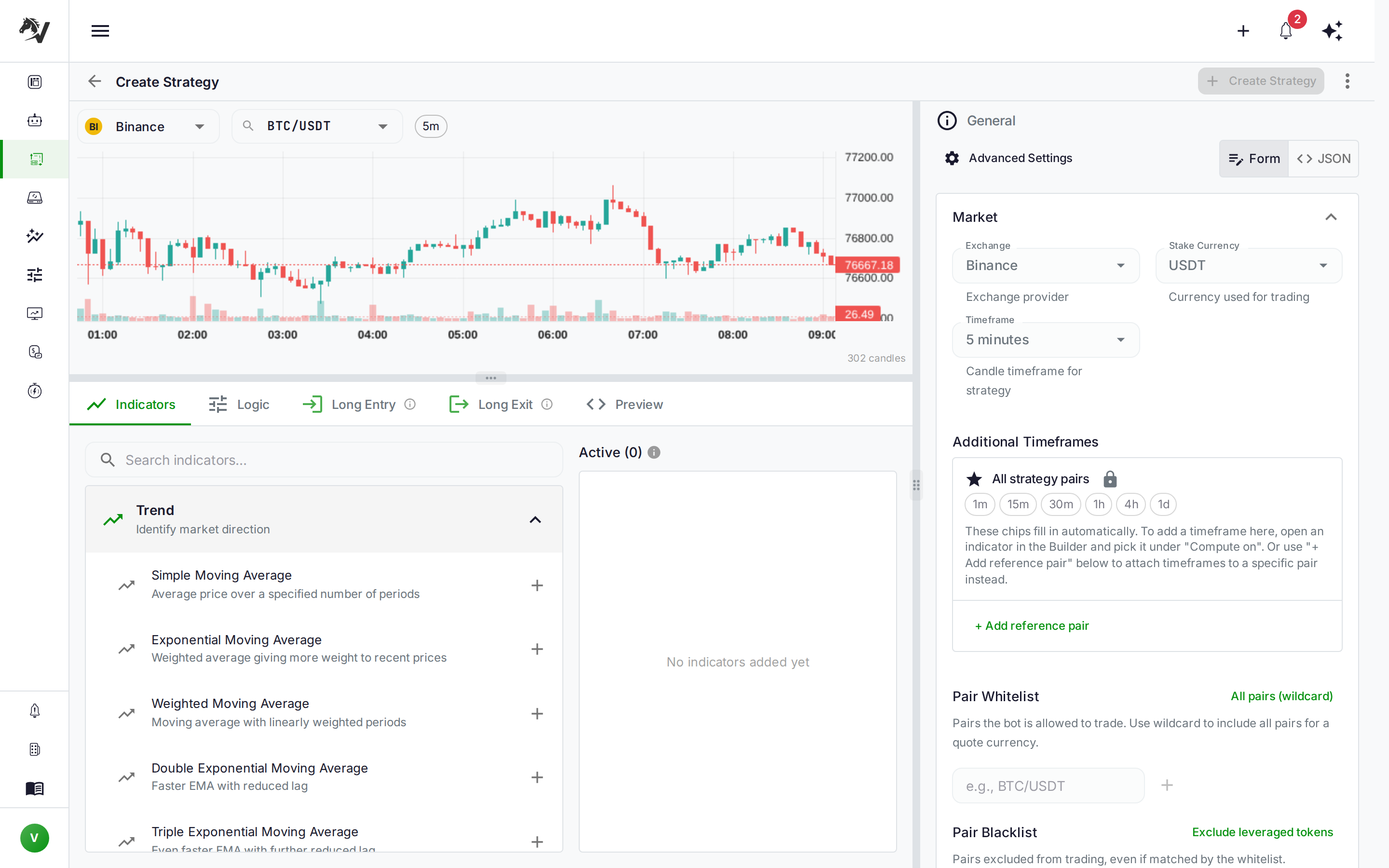
Setting the timeframe to 5m tells the bot to request 5-minute candles from the exchange and apply all indicator calculations at that resolution. When you run a backtest, the engine pulls 5-minute historical data automatically for the configured date range and pairs.
A typical scalping long-entry setup using the Strategy Builder:
- Add indicators: EMA(8), EMA(21), RSI(7), VWAP — all available in the indicator library
- Long entry conditions (Long Entry tab):
EMA_8 > EMA_21— positive micro-trendclose > VWAP— intraday buyer biasRSI_7 < 50— not yet overbought, room to run
- Long exit conditions (Long Exit tab):
RSI_7 > 65— momentum exhausted- OR
close < EMA_8— trend broken
The stop-loss slider in the Freqtrade config's Risk Management section sets a percentage-based stop from entry. For scalping, a tight stop — 0.3% to 0.8% — is typical. A wider stop inverts the risk/reward: risking 2% to make 0.3% is not a viable scalping setup regardless of win rate.
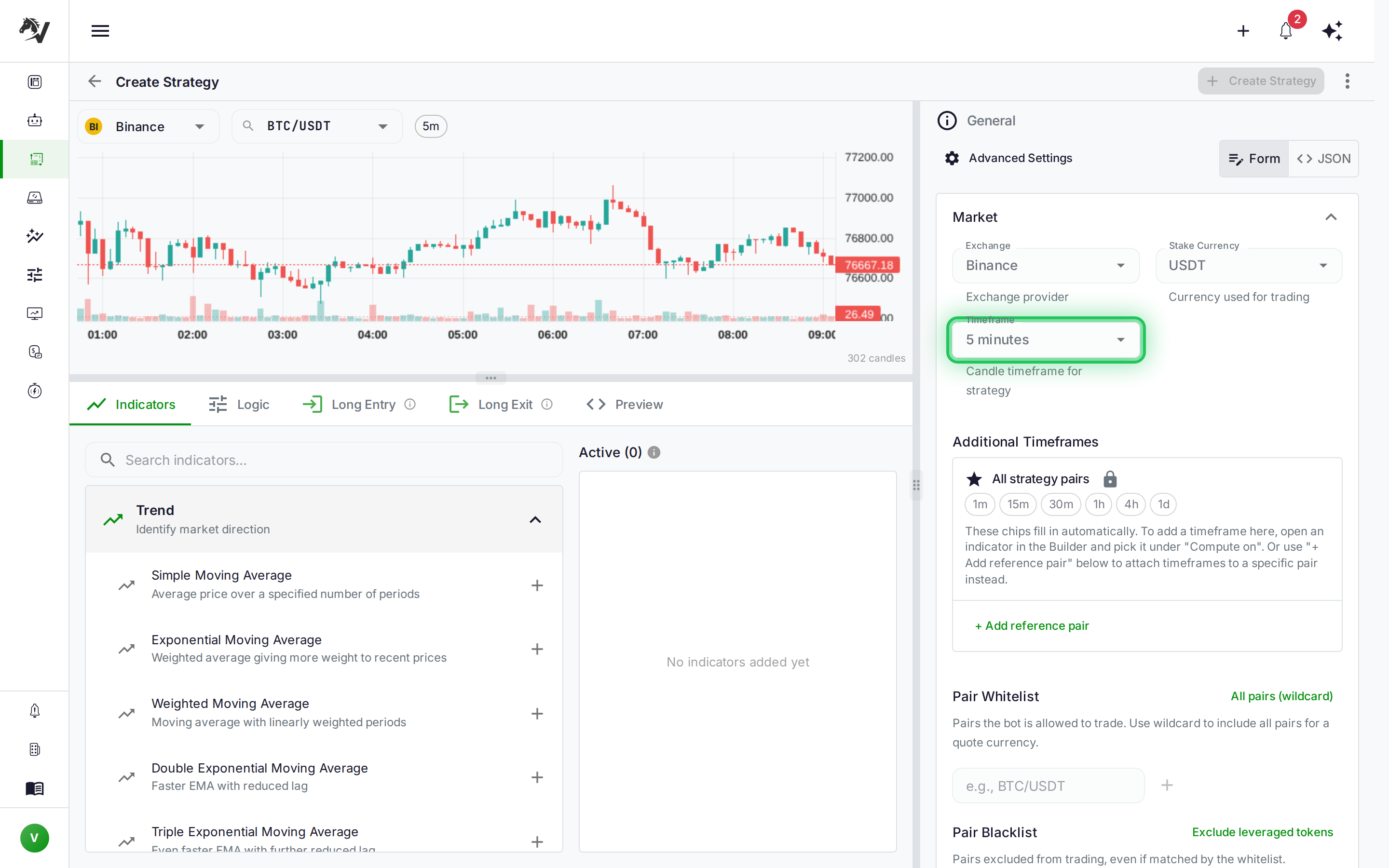
Backtesting Scalping Strategies
Running a backtest for a scalping strategy has two important differences from a daily-chart backtest.
Fee Modeling Is Non-Negotiable
VolatiCloud's backtest engine models trading fees per trade. At 5m with 30+ trades per day, fees determine whether a strategy is profitable or not. Always configure the correct fee tier before running any scalping backtest.
In the backtest configuration drawer, set fee to your actual exchange maker/taker rate:
- Binance BTC/USDT taker: ~0.10% (0.07% with BNB fee discount)
- Bybit BTC/USDT taker: ~0.10%
- Maker rates on major pairs: 0.02%–0.08% depending on volume tier
Running backtests with
fee: 0.0is the single most common scalping mistake. Results look excellent, the live bot loses money. Always model the real cost.
Data Granularity and Lookback
VolatiCloud fetches historical OHLCV data directly from exchanges. Most major pairs have 1m data going back 1–3 years on Binance and Bybit. Niche altcoin pairs often have shorter histories at minute-level resolution.
Run backtests across at least 6–12 months of 5m data to cover different market regimes — trending bull, sideways chop, high-volatility drops. A strategy optimized on a single 3-month trending period will likely fail when conditions change. The backtest overview explains how to select date ranges and verify data availability before committing to a run.
For deeper analysis after your initial backtest, analyzing backtest results covers how to read Sharpe ratio, drawdown, and profit factor — the metrics that matter most for evaluating scalping consistency.
High Trade Count Is a Double-Edged Sword
Scalping strategies generate far more trades than swing strategies over the same period. That's statistically valuable: 2,000 trades over 12 months provides much stronger signal than 50 trades about whether the edge is real. Confidence intervals are narrower; you can see regime-specific performance more clearly.
The downside is that more trades means more surface area for overfitting. With 2,000 trades, it's easy to tune parameters until the backtest looks perfect — and then watch it fail on new data. See Avoiding Overfitting in Backtests for the practical safeguards: out-of-sample testing, minimizing free parameters, and walk-forward validation.
Risk Management for Scalping Bots
Position Sizing
A bot trading 30–50 times per day with one open position at a time faces loss streaks that compress into hours rather than weeks. Apply the same position sizing principles as any other strategy — typically 1–3% of capital per trade — but account for the pace.
A 10-trade losing streak at 5m can happen in under two hours. Set a daily stop threshold: if the bot loses more than X% of capital in a single day, stop it and review. VolatiCloud's real-time bot monitoring lets you watch live equity curves and trade events; the daily stop itself is a manual intervention based on what you observe.
The risk management and position sizing guide covers the calculations in detail. The core principle applies regardless of timeframe: never risk more per trade than you can comfortably lose multiple times in a row.
Stoploss Configuration
For 5m scalping, percentage-based stops are simpler to reason about than dynamic ATR-based stops:
- Entry-based fixed stop: 0.5% below entry — tight, reduces losses, increases stop-outs
- Trailing stop: follows price up, locks in partial profit — suited for momentum scalps
VolatiCloud supports both via the config panel. Backtest both variants before going live; trailing stops often perform worse than fixed stops on noisy 5m data because frequent minor dips trigger early exits before the move completes.
Going Live: What to Watch
After you've validated a scalping strategy through backtesting and at least 2–4 weeks of paper trading (see Paper Trading Framework), the transition to live trading introduces real-world factors the backtest cannot capture:
Slippage. At 5m, a market order can fill 0.05%–0.20% away from the candle close price depending on pair liquidity. Strategies relying on tight entries should use limit orders with a small offset — this reduces slippage at the cost of occasional missed fills.
API latency. Bot runners geographically close to the exchange execute faster and see fewer rate-limit errors. VolatiCloud's cloud runners are deployed in regions with low latency to major exchanges. Self-hosted runners on your own infrastructure give full control over network topology.
Rate limits. At 1m, aggressive strategies can exhaust per-minute API quotas. Monitor runner logs for 429 Too Many Requests errors — a clear sign to reduce request frequency or move to a less crowded timeframe.
Even with a solid backtest and paper trading period, start your scalping bot at 20–30% of your intended capital for the first two weeks in live mode. Slippage and real fee tiers can shift performance significantly from paper results.
Summary
Scalping bots work, but they demand more careful engineering than swing strategies. The key principles:
- Model fees before anything else — scalping profitability is fee-sensitive by definition
- Use short-period indicators — match indicator lag to your timeframe
- Backtest on 6–12 months minimum — cover multiple market regimes
- Watch live performance closely — slippage and API behavior don't show up in backtests
VolatiCloud's Strategy Builder supports any timeframe down to 1m, full fee modeling in backtests, and real-time monitoring once your bot goes live. Start with a 5m setup, validate it through at least one month of paper trading, and scale only after confirming the live results match your backtest expectations.
Ready to build your first scalping bot? Open the VolatiCloud Strategy Builder, set your timeframe to 5m, add EMA(8), EMA(21), and RSI(7), and run a backtest with your exchange's real fee rate. The numbers will tell you whether the strategy has a genuine edge worth pursuing.
For deeper reading, see Running Backtests and Analyzing Backtest Results in the knowledge center.