Pairs Trading Crypto Bots: A Relative-Value Strategy Guide

Every strategy covered so far on this blog — RSI mean reversion, EMA crossovers, breakouts — shares one assumption: the asset you're trading will move in a predictable direction. Pairs trading drops that assumption entirely. Instead of betting BTC goes up or ETH goes down, you bet on the relationship between the two — and that relationship can be far more stable than either asset's price on its own.
What Pairs Trading Actually Is
Pairs trading is a market-neutral, relative-value strategy: you go long one asset and short a correlated asset at the same time, sized so that the combined position profits when the spread between them reverts to its historical relationship — regardless of which direction the broader market moves.
The mechanics, distilled:
- Find two assets whose prices normally move together (a stable correlation or, ideally, a mean-reverting spread).
- When the spread widens beyond its normal range — one asset outperforms, the other lags — go long the laggard and short (or reduce exposure to) the leader.
- Close both legs when the spread reverts to its historical mean.
If BTC and ETH typically move within a fairly tight ratio and ETH suddenly drops 8% while BTC drops 2%, a pairs trader isn't asking "will crypto go up or down" — they're asking "will ETH catch back up to BTC, or has something changed that decouples them." That's a fundamentally different, and often lower-variance, bet.
A pure pairs trade is hedged against market direction. It loses money when the spread diverges further, not when the market falls — a different risk profile from every directional strategy in this blog.
Why Correlated Crypto Pairs Exist
Crypto markets have unusually strong short-term correlation structure compared to traditional equities, for a few structural reasons:
- Shared liquidity and sentiment. Most altcoins are priced and traded against BTC or a BTC-denominated pair on the same exchanges, so a BTC move mechanically drags liquidity (and often price) across the board.
- Beta clustering. Large-cap alts like ETH, SOL, and BNB tend to move with BTC at a fairly stable multiple ("beta") most of the time, only decoupling during asset-specific news (an upgrade, an exploit, a regulatory action).
- Sector baskets. Layer-2 tokens, DeFi tokens, and meme coins each form their own correlated clusters that move together within the cluster more than they move with BTC.
None of this means correlation is constant — it isn't. Correlation regimes shift, and a pair that tracked tightly for six months can decouple permanently (a hack, a delisting, a fundamental narrative shift). That's the central risk of pairs trading, covered in detail further down.
Finding Candidate Pairs
Before configuring anything in VolatiCloud, do the pair selection work with your own historical data. Three checks matter, in order of importance:
| Check | What it tells you | Rule of thumb |
|---|---|---|
| Correlation coefficient | How tightly the two assets' returns move together | Look for 0.7+ over a rolling 90-day window |
| Spread stability | Whether the price ratio (not just returns) mean-reverts rather than trending | Plot assetA / assetB over time — you want a range-bound line, not a rising or falling one |
| Half-life of mean reversion | How long a typical spread deviation takes to close | Days, not weeks — a multi-week half-life ties up capital too long for most crypto position sizing |
Good starting candidates on major exchanges:
- ETH/BTC — the most liquid, most-studied crypto pair ratio; correlation is high but not perfect, especially around ETH-specific catalysts (upgrades, staking yield changes)
- Large-cap L1 pairs — SOL/AVAX, ADA/DOT — correlated by "alt L1" narrative exposure, decouple on ecosystem-specific news
- Liquid-staking derivative pairs — an LSD token against its underlying — usually the tightest spread of any crypto pair, but also the thinnest edge
Avoid thin pairs. A wide bid-ask spread on either leg eats the statistical edge before it has a chance to play out — this matters even more in a two-legged trade, since you pay the spread cost twice.
Before committing to a pair, confirm both assets have enough clean historical candle history on your target exchange and timeframe. The historical data availability guide covers the pre-flight check that saves you from discovering a data gap mid-backtest.
The VolatiCloud Approach: Two Legs, One Coordinated Portfolio
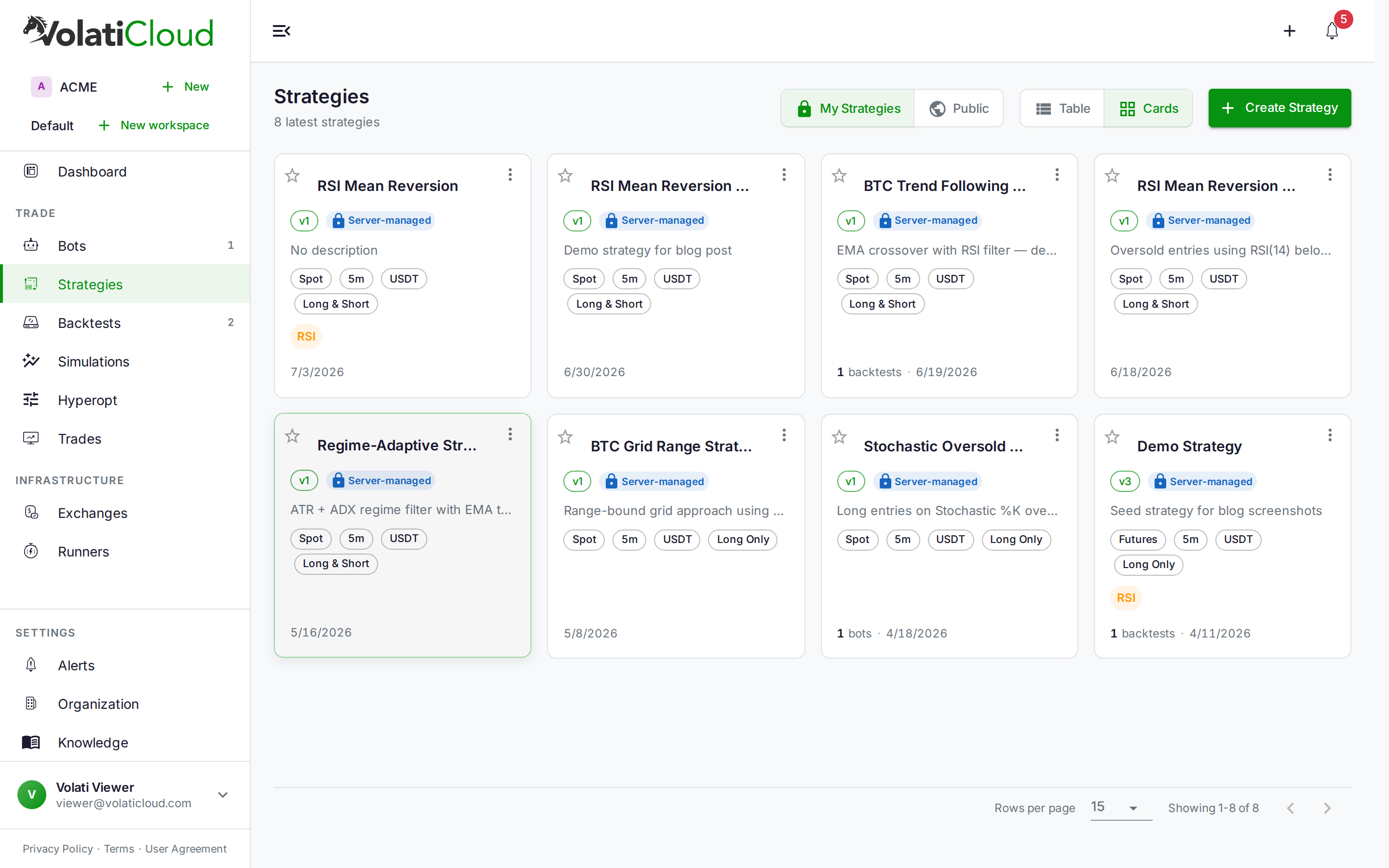
VolatiCloud's Strategy Builder generates single-pair Freqtrade strategies — each bot trades the pairs on its own whitelist using its own indicators and conditions. There's no built-in cross-asset spread operand that computes ETH/BTC as a single indicator inside one strategy. That's a deliberate simplicity trade-off, and it means a pairs trade in VolatiCloud isn't one exotic strategy — it's two ordinary, well-understood bots run as a coordinated pair, using tools already covered on this blog:
- Each leg is a normal single-asset strategy built in the Strategy Builder, typically a mean-reversion setup (RSI, Bollinger Bands) tuned to each asset's own volatility.
- The short leg uses Long/Short Mirror Mode or a dedicated
SHORT_ONLYstrategy, since going short requires a perpetual futures or margin-enabled exchange connection. - Both legs run under multi-bot portfolio orchestration so you can monitor them, size them, and alert on them as a single unit rather than two unrelated bots.
This is more honest about what's actually happening under the hood than pretending a single strategy can "know" about a second asset's price — and it has a real advantage: each leg gets independently backtested, independently monitored, and can be paused without touching the other.
Building the Long Leg: The Laggard
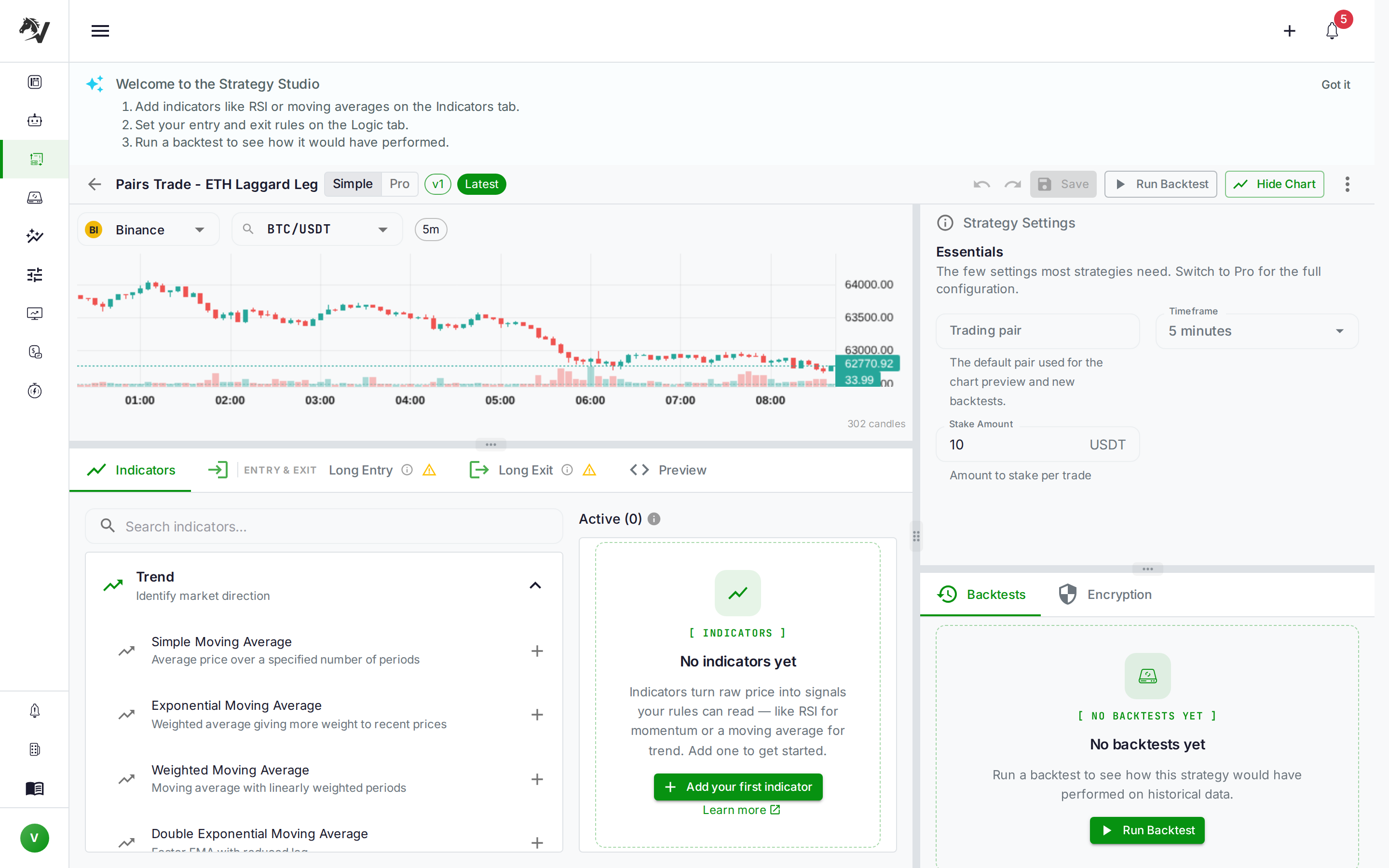
Start with whichever asset in your pair has fallen behind. A standard RSI mean-reversion configuration works well here, because a laggard leg is a bet that this specific asset's relative underperformance is temporary:
- In Strategies, click Create Strategy, name it clearly (
Pairs — ETH Laggard Leg), and select UI Builder. - On the Indicators tab, add an RSI(14) node.
- On the Long Entry tab, add a comparison:
RSI < 35— the laggard is oversold relative to its own recent range. - On the Long Exit tab, add:
RSI > 60, or use a fixed take-profit target sized to the pair's typical spread reversion magnitude. - Set Trading pair to the laggard asset (e.g.
ETH/USDT), timeframe to something liquid — 1h is a reasonable default for pairs that mean-revert over a few days.
The RSI mean reversion guide covers threshold selection in more depth if 35/60 doesn't fit your pair's volatility.
Building the Short Leg: The Leader
The second bot targets the asset that has outperformed. Two implementation options, depending on how symmetric you want the legs to be:
Option A — Mirror the long leg's logic on the leader asset. Fork the long-leg strategy, switch Trading pair to the leader asset, and set Position Mode to SHORT_ONLY. Entry condition becomes RSI > 65 (the leader is overbought relative to its own range); exit at RSI < 40.
Option B — Use Mirror Mode within a single LONG_AND_SHORT strategy if you want one bot capable of trading either side of the same asset depending on which role it's playing in a given spread cycle. This is more flexible but harder to reason about — most traders running their first pairs strategy get cleaner signal attribution from Option A's two fully separate bots.
Either way, shorting on crypto exchanges typically means perpetual futures, which carries funding-rate costs that eat into the spread-reversion edge over time. The long/short mirror mode guide covers funding rate mechanics and why they matter more for a short leg that might sit open for days waiting on mean reversion.
Sizing the Two Legs
The entire point of a pairs trade is that the two legs offset each other's directional exposure. That only works if they're sized correctly — an unbalanced pair is just two directional bets wearing a market-neutral costume.
A simple starting approach: dollar-neutral sizing. If the long leg stakes $500 in the laggard, the short leg should stake approximately $500 notional in the leader, not $500 in margin (leverage changes the notional exposure). Get this wrong and a broad market move — not a spread move — will dominate your P&L, defeating the purpose of running two legs at all.
More advanced traders use beta-adjusted sizing, weighting each leg by its historical volatility relative to the pair, so a 1% move in the low-volatility leg is offset by a proportionally smaller position in the high-volatility leg. This is worth layering in only after the basic dollar-neutral version has run cleanly in paper trading for a few weeks — see the position sizing guide for the underlying math.
Monitoring the Pair as a Single Unit
Once both bots are live, treat them as one position, not two independent bots. VolatiCloud's Bots page shows both legs with their own status, 7-day P&L, and trade history — check both cards together, not in isolation, since a healthy-looking long leg can mask a short leg quietly bleeding on funding costs.
Configure alert rules per leg using the types documented in the alert rules reference:
- A Drawdown Threshold alert on each leg individually — a pairs trade can still have one leg draw down hard even while the pair nets out
- A Large Profit/Loss alert on each leg so you notice quickly if one side is running away from the other (a sign the spread relationship may be breaking, not just fluctuating)
- A shared daily P&L review across both bots, following the portfolio-alert pattern from the multi-bot orchestration guide
The biggest pairs-trading risk isn't a losing trade — it's the pair permanently decoupling (an exploit, a delisting, a regulatory action against one asset specifically). No alert threshold catches "the relationship no longer exists." Re-check your correlation and spread-stability numbers on a fixed schedule, not just when a trade looks wrong.
Backtesting Both Legs Before Going Live
Backtest each leg independently over the identical date range using VolatiCloud's backtesting, then compare the two equity curves side by side rather than looking at combined P&L only. A few things to check specifically:
- Do the legs' drawdown periods overlap? If both legs lose money at the same time, they're not offsetting anything — you've built two correlated directional bets, not a hedge.
- Does one leg carry almost all the profit? If the short leg rarely triggers or consistently loses to funding costs, you may be better off running the long leg alone and accepting the directional exposure.
- What does the combined equity curve look like versus either leg alone? A working pairs trade should show a visibly smoother curve than either individual leg — that smoothing is the entire reason to run two bots instead of one.
Because pairs strategies rely on a mean-reversion assumption that can silently stop holding, validate with walk-forward optimization rather than a single fixed backtest window, and treat a spread-stability check from six months ago as stale — rerun it before committing new capital.
When Pairs Trading Isn't Worth the Complexity
Running two coordinated bots instead of one roughly doubles your operational overhead — runner capacity, credit consumption, alert surface area, and monitoring time. It's worth it when:
- You want exposure that's genuinely uncorrelated with the rest of a directional portfolio (see the multi-bot portfolio guide for how this fits into broader diversification)
- Your candidate pair has a demonstrably stable, mean-reverting spread — not just "these two coins seem to move together"
- You're comfortable with the added cost of shorting (funding rates, margin requirements) eating into a spread edge that's often thinner than a directional strategy's edge
It's usually not worth it if you're new to automated trading. Get comfortable with a single directional strategy, paper trade it, and understand your platform's backtesting and alerting tools before adding a second, interdependent bot to the mix.
Getting Started
Pick a pair with a genuinely stable historical spread — ETH/BTC is the easiest place to start — and build the long leg first as an ordinary RSI mean-reversion strategy. Backtest it alone, confirm it performs the way you expect on its own, then add the short leg and compare the combined curve. Only go live once both legs have run cleanly in paper trading and you've confirmed the alert rules on each are actually firing.
Open the VolatiCloud console to build your first leg in the Strategy Builder, or read the Strategy Builder documentation for the full reference on indicators, position modes, and mirror configuration.