VolatiCloud: Cloud Crypto Trading Bot Platform on Freqtrade

The first time you paste a Freqtrade strategy into VolatiCloud, it lands in the same editor a few hundred other traders are using right now — some debugging a stoploss, some running their fourth backtest of the day, one starting a live bot after three weeks of paper trading the same RSI setup. This isn't a demo or a pitch deck: it's a working system that traders rely on in production, with real exchange connections, real backtest engines, and real money on the line.
VolatiCloud is a cloud-native crypto trading bot platform built on top of Freqtrade. This post walks through what it does, who it's for, and why we built it the way we did.
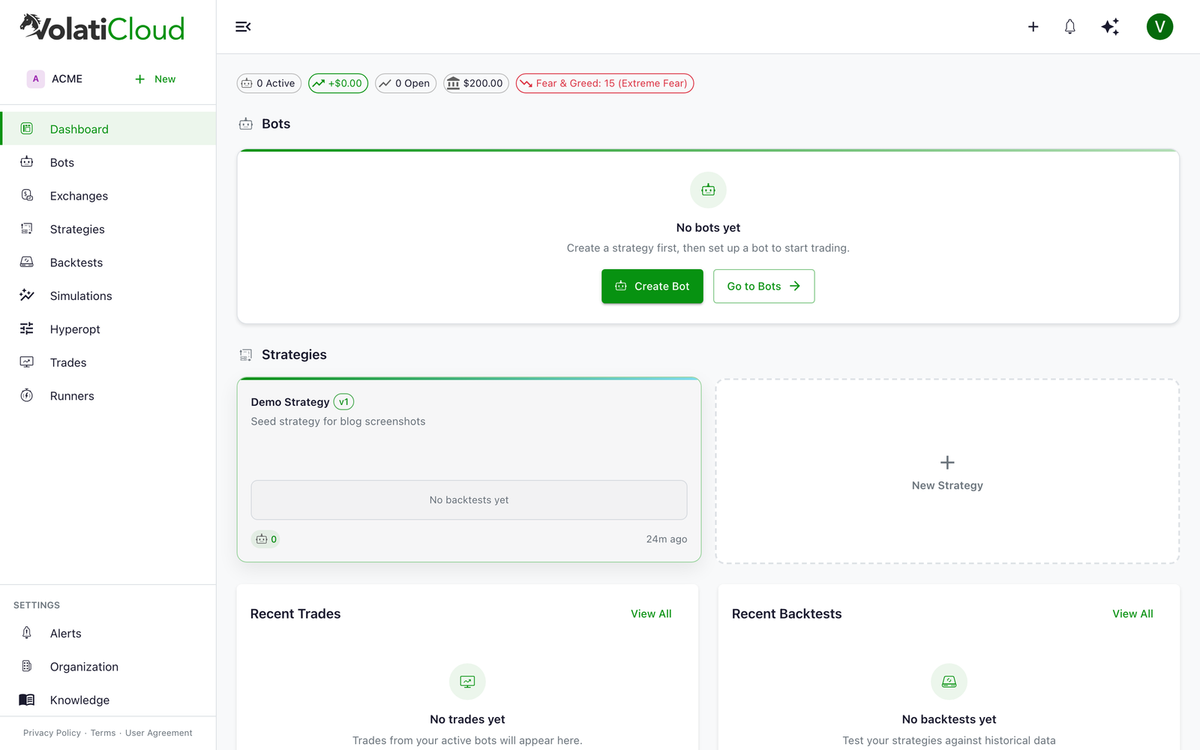
The Problem: DevOps Eats Trading Time
Running an algorithmic trading bot reliably means solving an infrastructure stack before you can even touch the strategy:
- Standing up servers to keep bots running 24/7
- Managing exchange API connections securely (without leaking keys to GitHub)
- Building a backtesting pipeline that handles years of OHLCV data
- Watching positions across multiple bots in real time
- Recovering from crashes, restarts, and exchange API rate limits
Traders with strong strategy intuition stall on the DevOps layer. Developers who can handle infrastructure spend weeks on it instead of iterating on signals. Either way, the strategy work — the part that actually generates returns — gets the leftover time. VolatiCloud takes the infrastructure off your plate so the strategy is the only variable left.
The Visual Strategy Builder: From Idea to Backtest in Minutes
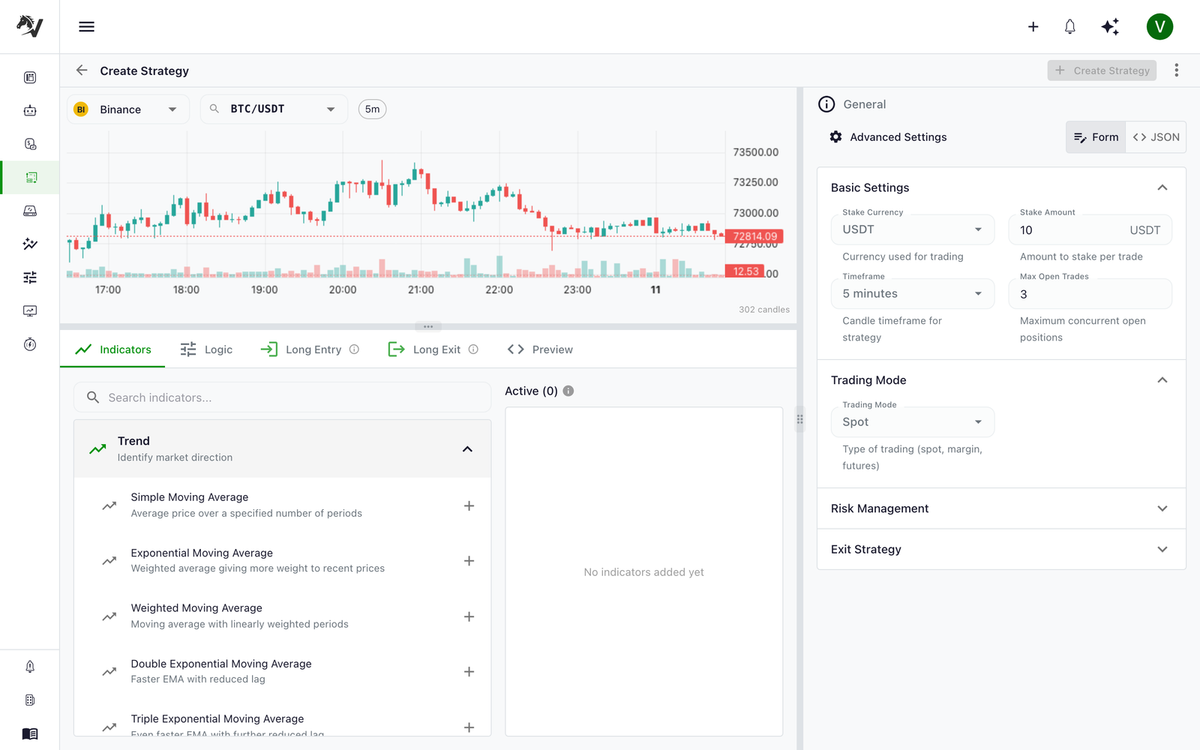
The visual condition editor lets you build trading strategies by connecting indicator nodes, comparison operators, and AND/OR/NOT logic trees — without writing Python. Pick from 25+ built-in indicators (RSI, MACD, Bollinger Bands, EMA, ATR, Ichimoku, and more), define entry and exit conditions, configure parameters. The builder generates Freqtrade-compatible Python code automatically. When you outgrow the visual layer, click Eject to Code and continue with the full Freqtrade API.
For a deeper walkthrough, see the no-code strategy builder post.
Built on Freqtrade — Industry-Standard Engine
VolatiCloud isn't a from-scratch reimplementation. Every bot runs on Freqtrade, the most widely used open-source crypto trading engine, with years of community development, a mature plugin ecosystem, and support for 100+ exchanges via CCXT. That gives you:
- Production-tested execution logic, not a v0.1 trading engine
- Full Python strategy API when you need callbacks, custom stoplosses, or DCA logic
- The standard Freqtrade backtesting engine — same numbers other Freqtrade traders see
- An active OSS community behind the underlying engine
If you already have a Freqtrade strategy, paste it into Code Mode and run a backtest in the next click.
Multi-Exchange Trading Across 14 Venues
This section originally listed Coinbase Advanced and Bitfinex, neither of which has ever been in the VolatiCloud catalog, and omitted Hyperliquid and MyOKX (EEA), which are. The real 14 are below. It also implied that every venue takes a live API key: live trading runs on the venues where VolatiCloud can prove the key is withdrawal-disabled, and all 14 work for market data, backtesting and dry-run bots. See supported exchanges.
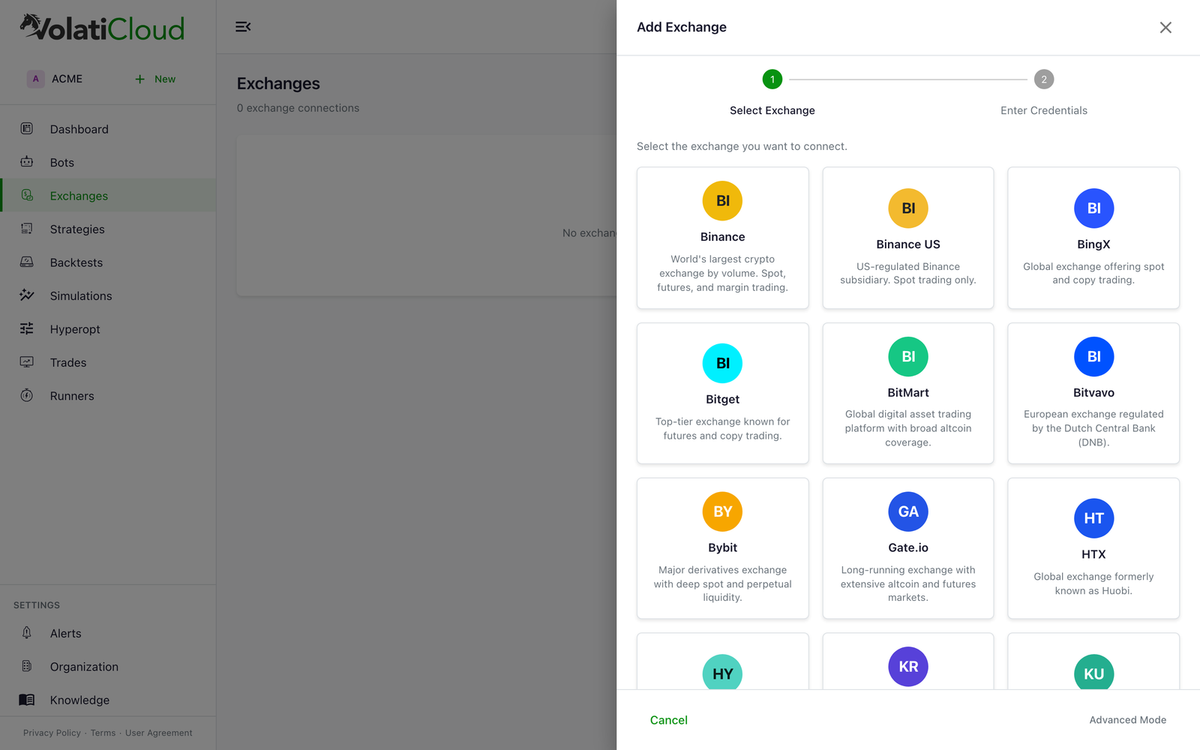
14 major exchanges — Binance, Binance US, BingX, Bitget, BitMart, Bitvavo, Bybit, Gate.io, HTX, Hyperliquid, Kraken, KuCoin, OKX, and MyOKX (EEA) — all available for market data, backtesting and dry-run bots, with no credential needed. Live trading runs on Binance, Bybit, Kraken, KuCoin, OKX and MyOKX, the venues whose permission API lets VolatiCloud prove your key cannot withdraw. Spot, margin, and futures where the venue supports it. Keys that do get stored are encrypted with AES-256-GCM field-level encryption before they hit the database — even with full database access, an attacker cannot read your credentials in plaintext.
The multi-exchange post covers per-exchange capability and which strategies suit which venues.
Backtesting With Institutional-Grade Metrics
Test strategies against years of historical data and get the metrics that actually matter:
- Sharpe ratio — return per unit of total volatility
- Sortino ratio — return per unit of downside volatility
- Calmar ratio — return relative to max drawdown
- Profit factor — gross wins divided by gross losses
- Max drawdown — worst peak-to-trough decline
- 15+ additional metrics including expectancy, win rate, average trade duration, and per-pair breakdowns
For the full breakdown of how to read these results, see the crypto backtesting deep dive. To stress-test results beyond the single historical path, Monte Carlo simulation randomizes trade sequences and shows you the distribution of plausible outcomes.
Real-Time Bot Monitoring
WebSocket-powered dashboards push trade events, P&L changes, and runner health directly to the browser — no polling, no page refresh. You can watch open positions, equity curves, CPU/memory usage, and per-bot logs across your whole portfolio in a single tab.
Smart Alerting Without the Noise
A bot that crashes at 3AM with an expired API key is the canonical "find out the next morning" failure. VolatiCloud's alerting system catches that specific case and the dozens like it: bot errors, drawdown breaches, daily loss limits, large losses, connection issues, and trade events. Critical alerts go out immediately; routine events batch into digests so your inbox doesn't fill up every time a trade closes. The intelligent alerts post covers the full alert taxonomy and severity model.
Three Deployment Models for the Bot Runtime
The same control plane drives three runner types — pick the one that fits your trust model and operational constraints:
| Runner | Where bots run | Best for |
|---|---|---|
| Cloud-managed | VolatiCloud Kubernetes cluster | Solo traders who don't want to manage infrastructure |
| Docker (self-hosted) | Your VPS or local server | Operators who want full control of the bot process |
| Kubernetes (self-hosted) | Your K8s cluster | Teams running 10+ bots with HA requirements |
The control plane (strategy editing, backtest results, alerts) always lives in the VolatiCloud cloud. The data plane (the actual Freqtrade process placing orders) lives wherever you choose. For self-hosted runners, your API keys are encrypted in transit, decrypted only on the runner, and never written to disk in plaintext. For the full trade-off matrix, see the cloud vs self-hosted runner guide.
Drive VolatiCloud With an LLM (MCP Server)
VolatiCloud ships an MCP server that exposes the platform to Claude Desktop, Cursor, and any MCP-compatible client. From a chat interface, you can:
- Create strategies, run backtests, and read live metrics through natural language
- Compare strategy versions side by side
- Pull trade history into the model context for analysis
- Trigger hyperopt runs and review results without leaving the conversation
The MCP server post covers the setup. For an example of using the AI chat assistant inside the dashboard, see AI chat assistant.
Who Uses VolatiCloud
Solo traders who want systematic strategies without managing servers. Start with the visual builder, validate in dry-run mode, then promote to live with a small stake.
Developers who want the full Freqtrade API without the infra overhead. Bring your own Docker or K8s, or run on managed infrastructure.
Trading teams that need role-based access — shared exchange connections and strategies without sharing API keys or billing credentials. The team management post covers the role model and the view-secrets scope that keeps API keys segregated even within an org.
Funds and prop desks running multi-strategy portfolios. Per-bot isolation, audit trails, and Kubernetes-backed runners with horizontal scaling. The multi-bot portfolio orchestration post covers how to run a portfolio without correlated drawdowns blowing up your capital allocation.
Security Model
A short list of what we do and what we don't do:
- API keys encrypted with AES-256-GCM at the field level — separate encryption key, never logged
- We never ask for or store withdrawal permissions
- UMA 2.0 authorization for fine-grained per-resource permissions
- Multi-tenant isolation — your strategies, bots, and trades are never visible to other organizations
- Open-source backbone (Freqtrade) — no proprietary black-box trading logic
The exchange API key security guide walks through how to lock down your API keys at the exchange level too.
Getting Started
The fastest path from sign-up to your first paper-trading bot:
- Sign up at console.volaticloud.com — a new org starts on the Free plan, which has no bots, so start the 7-day Pro trial with $60 of credits from Organization → Billing; a card is collected at checkout and nothing is charged before day 7
- Build a strategy in the UI Builder — start with the RSI + EMA template
- Run a backtest over 12+ months of historical data
- Connect an exchange (testnet API keys work fine for first runs)
- Deploy a bot in Dry Run mode and watch it trade against real market data without risk
Prefer to browse before signing up? The volaticloud.com homepage has the full feature tour, and the pricing page breaks down what each plan includes.
The Quick Start guide walks through the whole flow in about 20 minutes.
If you want the deeper feature posts, the team management, multi-exchange support, and backtesting deep dive posts each go further on their respective areas. The documentation is the canonical reference for everything else.